
| CV |
Email |
Google Scholar |
|
I am a third-year B.Eng. student in Electronic Science and Technology at Guangdong University of Technology, advised by Prof. Panshuo Li. I am also a Research Assistant at The Chinese University of Hong Kong, working with Prof. Hongliang Ren. My research lies at the intersection of embodied intelligence, robot learning, and medical robot autonomy. I develop Vision-Language-Action and World-Action Models that connect multimodal perception, predictive world modeling, and visuomotor control for robust robotic decision-making. My current work focuses on surgical video prediction, grounded endoscopic navigation, and executable world-action modeling for robot-assisted endoscopic intervention. Email:3123006457[AT]mail2.gdut.edu.cn |
| * Equal contribution; † Corresponding author. |
|
pdf |
abstract |
arXiv
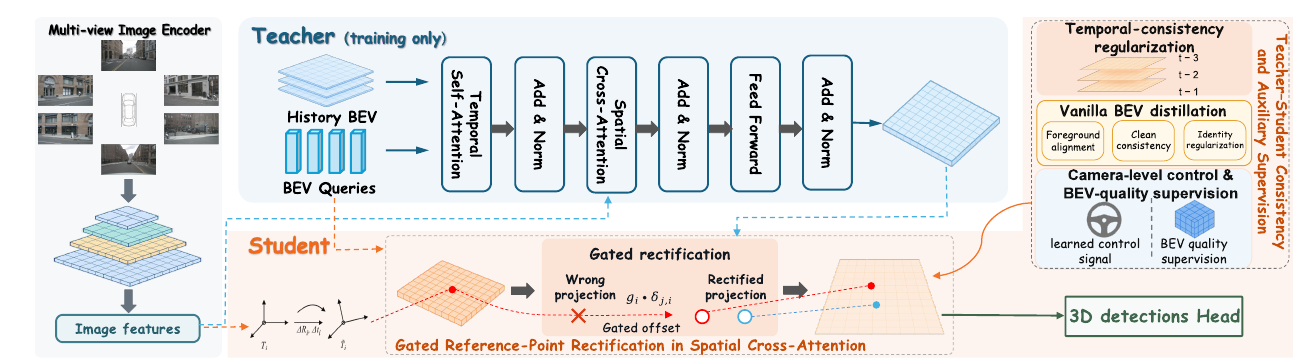
Camera-based bird's-eye-view (BEV) 3D detection typically assumes accurate and fixed camera extrinsics. In detectors using spatial cross-attention (SCA), extrinsic perturbations displace the image-plane projections of BEV reference points, causing queries to sample features from incorrect regions and degrading detection performance. To address this failure mode, Noise-Conditional Gated Rectification (NCGR) is proposed to compensate for projection errors without explicitly estimating a full six-degree-of-freedom extrinsic correction. For each query-camera pair, a 2D rectification offset is predicted and modulated by a camera-level gate to rectify the base projection before native deformable sampling. During training, the perturbation-derived quantities used to construct the condition and gate are gradually replaced through scheduled interpolation by counterparts generated from an auxiliary scalar predicted from camera features. This transition enables blind inference without perturbation metadata. During training, a weight-shared clean-teacher/perturbed-student pair is used, and the rectification module is supervised by a BEV-consistency objective between the two branches. NCGR is evaluated on nuScenes with simulated dynamic and static extrinsic perturbations. In a five-camera dynamic stress test, NCGR achieves 39.69% NDS, compared with 28.00% for BEVFormer and 33.23% for CAPE. Under clean extrinsics, NCGR maintains performance comparable to that of BEVFormer. |
|
webpage |
pdf |
abstract |
arXiv
Visual world models typically learn future dynamics from a single observation stream, limiting their ability to model cooperative systems with multiple independently moving observers. We investigate this challenge in Mother--Child endoscopic retrograde cholangiopancreatography (ERCP), where two flexible scopes provide complementary yet role-dependent views without a calibrated stereo relationship. Unlike conventional multi-view fusion that assumes symmetric information exchange, we formulate role-asymmetric dual-scope future prediction, where cross-view evidence is selectively transferred according to the prediction target and its underlying spatial requirements. We propose CrossScope, a dual-stream surgical world model that preserves view-specific experts while enabling target-specific evidence routing through geometry-guided residual interactions. CrossScope learns two complementary communication directions: geometric motion cues from the Mother view guide Child-view future dynamics, while pose-aligned Child appearance supports Mother-view prediction only when valid spatial correspondence is established. This design allows each scope to contribute task-relevant evidence without compromising its view-specific representation. To evaluate this problem, we establish a paired dual-scope benchmark comprising synchronized phantom and real-world ERCP episodes, with evaluations assessing visual fidelity, structural preservation, target localization, and motion consistency. Experiments demonstrate that CrossScope consistently outperforms strong surgical video generation baselines, validating the importance of role-aware evidence routing for multi-observer visual world modeling. |
|
|
pdf |
abstract |
arXiv
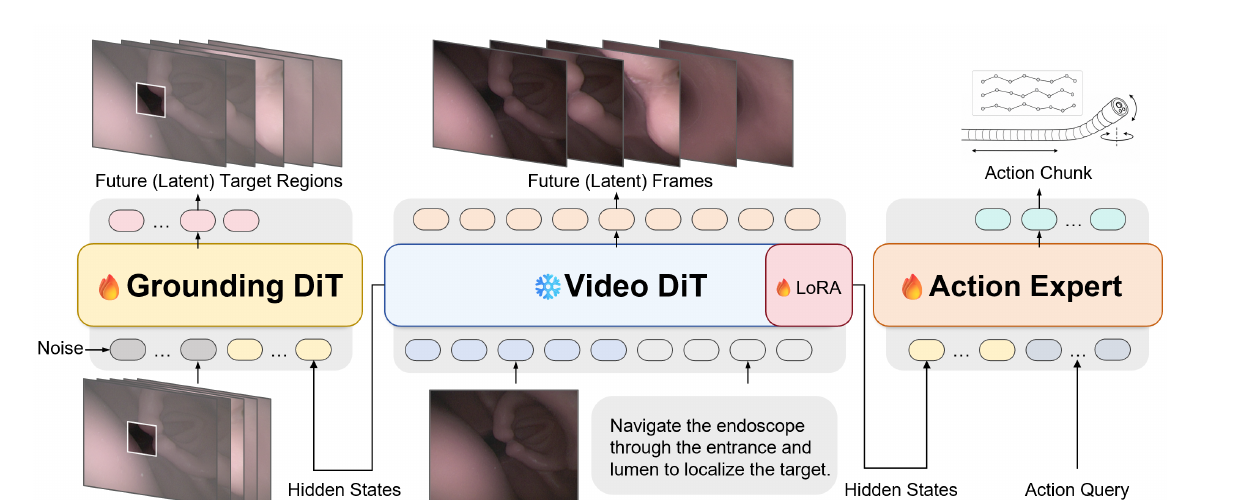
Autonomous endoscopic navigation can reduce clinicians' operational burden, yet robust control remains challenging due to tissue deformation, transient occlusions, and rapidly changing viewpoints. Existing learning-based policies typically predict actions from current observations without explicitly modeling future dynamics, limiting their robustness and reliability in safety-critical settings. World Action Models (WAMs) offer a promising alternative by coupling predictive visual dynamics with action generation, but extending them to robotic endoscopy remains challenging due to limited training data, restricted viewpoint diversity, deformable anatomy, and high inference latency. We present EndoWAM, which is, to our knowledge, the first WAM for generalizable robotic endoscopic navigation. EndoWAM introduces future grounding, which predicts task-relevant target regions in future observations from intermediate denoising features of a video world model. Specifically, EndoWAM couples a lightweight diffusion transformer for future target-region prediction with a discrete action expert through a shared predictive representation. This design injects target-aware supervision into predictive dynamics modeling, improving robustness to visual degradation and viewpoint changes while enabling real-time control in a single denoising pass. We further introduce EndoMotion, a robotic endoscopic motion dataset spanning three anatomically distinct procedures: ureteroscopy, esophagoscopy, and endoscopic retrograde cholangiopancreatography (ERCP). EndoWAM consistently outperforms all baselines and alternative grounding strategies, while demonstrating strong zero-shot generalization to unseen viewpoints, environments, and targets. These results establish EndoWAM as a predictive, target-grounded framework for accurate, generalizable, and long-horizon navigation in visually constrained endoscopic environments. |
|
|
Wanhao Liu, Junhong Dai, Yixuan Zhang, Shengyun Yin, Panshuo Li† 2026 AAMAS (Oral)
abstract
Cooperative path planning for heterogeneous UAV swarms posessignificant challenges for Multi-Agent Reinforcement Learning(MARL), particularly in handling asymmetric inter-agent dependencies and addressing the risks of sparse rewards and catastrophicforgetting during training. To address these issues, this paper proposes an attentive curriculum learning framework (AC-MASAC)The framework introduces a role-aware heterogeneous attentionmechanism to explicitly model asymmetric dependencies. Moreover, a structured curriculum strategy is designed, integrating hierarchical knowledge transfer and stage-proportional experiencereplay to address the issues of sparse rewards and catastrophicforgetting. The proposed framework is validated on a custom multi.agent simulation platform, and the results show that our methodhas significant advantages over other advanced methods in termsof Success Rate, Formation Keeping Rate, and Success-weighted
  @article{luo2025prescribed,
    title={Prescribed-time fault-tolerant attitude control for tiltrotor UAV with input saturation and mismatched disturbances},
    author={Luo, Liwei and Liu, Wanhao and Yuan, Li and Cai, Qianqian and Li, Panshuo},
    journal={Control Engineering Practice},
    volume={164},
    pages={106526},
    year={2025},
    publisher={Elsevier}
  }
|
|
|
Junhong Dai, Yue Cui, Wanhao Liu, Panshuo Li CVCI 2025
abstract
Multi-vehicle coordination problem in unsignalizedintersections is a challenge due to its complexity in vehicle trajec.tories. In this paper, we formulate the multi-vehicle coordinationproblem in unsignalized intersections into a markov decisionprocess (MDP)and then resort to reinforcement learning-basedmethods. Considering that intersections are more common tocollisions than other scenarios, we proposed a collision risk function to measure the degree of collision risk between confictingvehicles, And then a novel confict prioritized-based experiencereplay soft actor-critic (CPERSAC)algorithm is proposed tomake decision for connected and autonomous vehicles (CAVs).Finally, the simulation is conducted under ROS-noetic and theresults demonstrate the superiority of proposed algorithm ineffciency and safety of coordination.
  @article{luo2025prescribed,
    title={Prescribed-time fault-tolerant attitude control for tiltrotor UAV with input saturation and mismatched disturbances},
    author={Luo, Liwei and Liu, Wanhao and Yuan, Li and Cai, Qianqian and Li, Panshuo},
    journal={Control Engineering Practice},
    volume={164},
    pages={106526},
    year={2025},
    publisher={Elsevier}
  }
|
|
|
pdf |
abstract |
bibtex |
This paper proposes an observer-based prescribed-time adaptive control strategy for attitude control of tiltrotor unmanned aerial vehicle (TRUAV), under mismatched disturbances, actuator faults, and actuator saturation. To deal with the mismatched disturbances, a prescribed-time mismatched disturbance observer is designed. Based on it, an adaptive sliding mode-based fault-tolerant control method is introduced to address actuator faults in TRUAV attitude control. Moreover, a prescribed-time auxiliary dynamic system is constructed to tackle the input saturation caused by physical limitations. The proposed control strategy ensures that the TRUAV attitude tracking error could converge within a prescribed time, even during the transition mode under complicated conditions, that would be more favorable in applications. Hardware-in-the-loop experiments are conducted to validate the effectiveness of the proposed method.
  @article{luo2025prescribed,
    title={Prescribed-time fault-tolerant attitude control for tiltrotor UAV with input saturation and mismatched disturbances},
    author={Luo, Liwei and Liu, Wanhao and Yuan, Li and Cai, Qianqian and Li, Panshuo},
    journal={Control Engineering Practice},
    volume={164},
    pages={106526},
    year={2025},
    publisher={Elsevier}
  }
|
|
|
pdf |
abstract |
bibtex |
In this paper, we propose an improved heuristic JPS algorithm for path planning in intelligent warehouse robots. We first analyze the limitations of the original JPS algorithm and propose a new heuristic function that considers the distance to the goal and the cost of the path. We then implement the algorithm and test it on a real warehouse robot. The experimental results show that the improved algorithm significantly improves the path planning performance.
  @inproceedings{zhang2024improved,
    title={Improved Heuristic JPS Algorithm for Path Planning in Intelligent Warehouse Robot},
    author={Zhang, Yixuan and Liu, Wanhao and Liu, Libin},
    booktitle={2024 8th International Conference on Electrical, Mechanical and Computer Engineering (ICEMCE)},
    pages={1211--1214},
    year={2024},
    organization={IEEE}
  }
|

|
Code
This data-driven smart car project achieved low-latency, real-time inference and precise environmental perception on the Jetson Orin Nano platform by deeply integrating deep learning with multi-sensor information. The integration of a coordinatively multi-task robotic arm and a stable projection mechanism ensured the vehicle could perform physical tasks rapidly and accurately after identifying targets, earning a National Second Prize in the national finals. |
|
|